Mealtime adventures are better with Bibado! Let our award-winning products make a difference to your weaning journey.
 Shop Now
BASKET
Your basket is empty
Mealtime adventures are better with Bibado! Let our award-winning products make a difference to your weaning journey.
Shop Now
Article: Your Baby’s Mealtime Toolkit: 7 Skills They’re Building Right Now
Your baby isn’t simply learning how to finish a meal. They’re developing increasingly complex motor, sensory and feeding skills that will help them become more capable and independent as they grow.
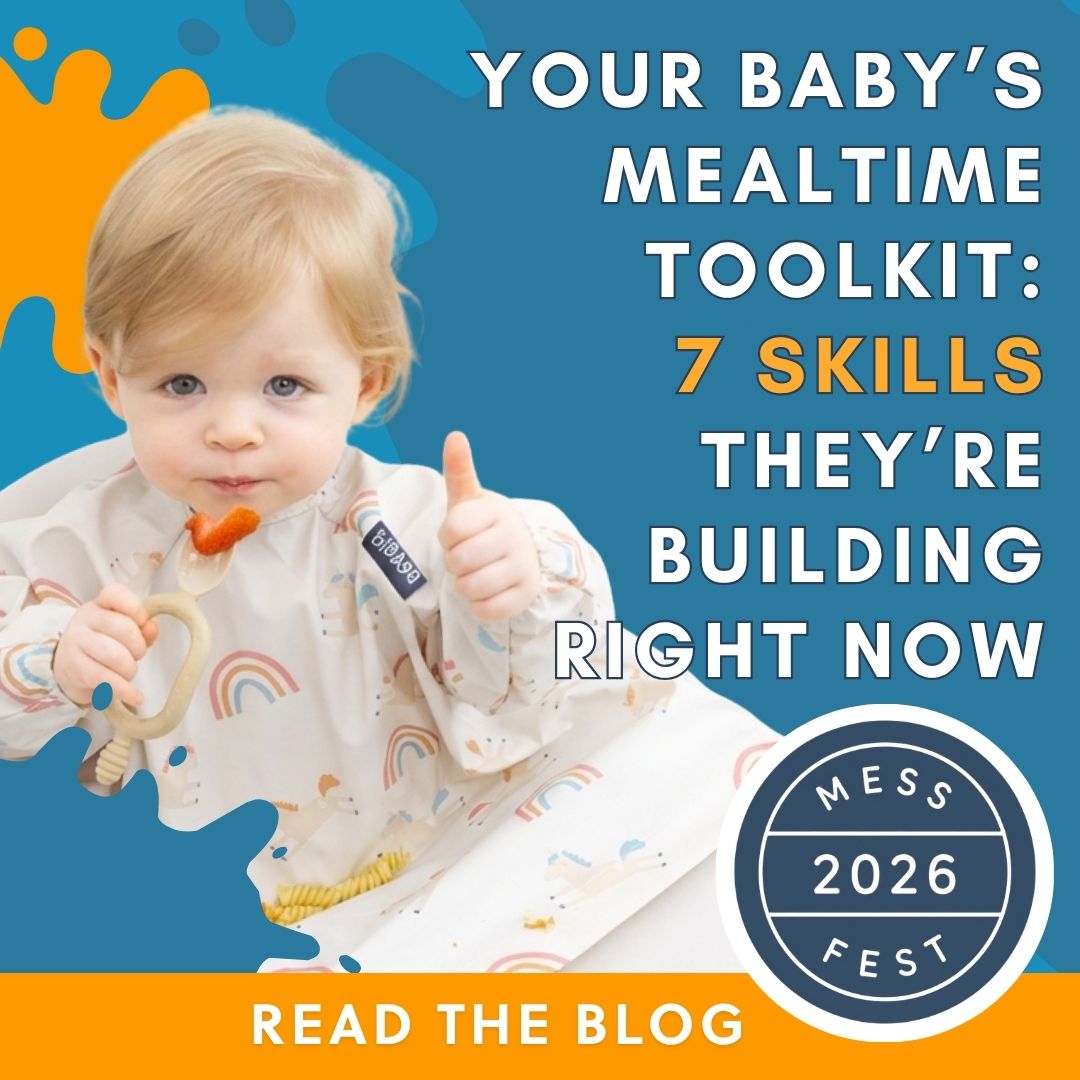
Over the course of Mess Fest, we’ve explored why mess matters, taken a peek at what’s happening inside your baby’s brain and tackled everything from allergens and constipation to food acceptance, repetition and those inevitable mealtime ups and downs.
A lot of weaning advice understandably focuses on the here and now. So, for our final Masterclass, we want to look ahead.
Because behind the dropped spoons, squished banana, and yoghurt splats, there’s a lot of rather delightful development happening.
Your baby isn’t simply learning how to finish a meal. They’re developing increasingly complex motor, sensory and feeding skills that will help them become more capable and independent as they grow.
So, as Mess Fest draws to a close, here are seven skills hiding amongst all that mess — and where they might eventually lead.
Building now: Fine motor control and grasp development
At the beginning of weaning, your baby is likely to be much better at grabbing than picking.
Early finger foods are deliberately served in pieces big enough for babies to grasp in their fist, because their hand skills are still developing. As control improves, that whole-hand palmar grasp becomes increasingly refined. Eventually, babies begin using a pincer grasp, bringing the thumb and index finger together to pick up much smaller objects — including little pieces of food.
Suddenly, that lone pea or tiny piece of pasta becomes a brilliant little fine-motor challenge.
Where it can lead:
Pincer grip is about much more than picking up food. Occupational therapy guidance describes it as an important precise grasp used later for tasks including holding pencils and scissors, manipulating buttons and zips and eventually managing shoelaces.
Building now: Hand-eye coordination
Watch a baby trying to feed themselves, and you can almost see the calculations happening.
There’s the food. There’s my hand. There’s my mouth. Now how do I get one to the other?
Self-feeding requires the eyes, hands and mouth to work together. In fact, being able to coordinate the eyes, hands and mouth sufficiently to look at food, pick it up and bring it towards the mouth is one of the developmental signs the NHS uses when describing readiness for solid foods.
At first, accuracy may be sketchy. But reaching, grasping, aiming and trying again provide repeated opportunities to practise that coordination.
Where it can lead:Those same visual-motor skills are gradually recruited for more demanding everyday tasks — loading a spoon, drinking from a cup and setting it back down, using cutlery, and manipulating objects accurately with the hands.
Building now: Crossing the midline and bilateral coordination
Put different foods across a plate or eating surface and you may notice your baby reaching across their body to investigate them.
That movement has a developmental name: crossing the midline.
The midline is the imaginary line running down the centre of the body. Crossing it means, for example, reaching with the right hand into the space on the left-hand side.
Paediatric occupational therapy guidance describes midline crossing as important for helping the two sides of the body work together in a coordinated way.
Closely connected to this is bilateral coordination — the ability to use both sides of the body together.
Where it can lead:
Think about how many everyday childhood tasks require two hands to do different jobs at the same time: holding a bowl while stirring, holding paper while cutting, pulling up trousers, fastening clothing or eventually using a knife and fork together.
NHS occupational therapists specifically identify knife-and-fork use as a bilateral coordination task.
So reaching across the plate for that piece of toast is an investment in future tasks.
Building now: Oral mapping, sensory processing and oral-motor coordination
Before your baby can confidently manage a mouthful of family food, they first have to learn something surprisingly fundamental: what’s going on inside their own mouth.
This is sometimes described as mouth mapping — building an internal picture of where the tongue, lips, gums and jaw are, how they move and what different sensations feel like.
During weaning, every safe new texture gives the mouth something slightly different to process. Smooth yoghurt behaves differently from mashed avocado. Soft broccoli requires a different response from toast. A lump needs to be located, moved with the tongue, positioned for chewing and organised into something that can eventually be swallowed.
That sensory information and repeated practice help babies become increasingly skilled at managing food in their mouths.
And this learning can start before weaning. A multi-sensory teether such as Dotty the Dinosaur gives babies an opportunity to explore different shapes, surfaces and positions in their mouth, providing varied sensory feedback as they move their tongue, jaw and lips around it.
Where it can lead:As those sensory and oral-motor skills become more organised, your child can begin to bite, chew, move and safely swallow increasingly complex textures — an important part of graduating from early weaning foods towards the mixed textures and family meals eaten by everyone else at the table.
Many of the same structures involved in eating — including the tongue, lips and jaw — are also used for speech. That doesn't mean practising chewing or using a teether teaches a baby to talk. But developing increasingly controlled, coordinated movements of the mouth forms part of a much broader programme of oral development that later includes speech as well as eating.
So all that mouthing, chewing, tasting and experimenting isn't simply about getting through today’s meal. Your baby is gradually building a map of their mouth — and learning how to use it.
Building now: Sensory processing and food familiarity
Food is an enormous sensory experience.
A baby doesn't simply taste yoghurt. They feel that it’s cold, wet, slippery and sticky. They discover that toast is dry and rough and avocado squashes between their fingers.
Touching and exploring foods gives babies information about texture, temperature, shape, smell, taste and consistency before — and while — they learn to eat them.
Feeding specialists recognise sensory processing as an important part of feeding: tolerance of different textures, temperatures, tastes and consistencies all form part of a child’s feeding skills.
Where it can lead:Each experience adds to your baby’s sensory knowledge of food. Over time, foods that were once completely novel can become more familiar and predictable.
That matters because early food learning isn't simply about whether something was swallowed on attempt number one. Weaning research consistently finds that repeated exposure supports acceptance of unfamiliar foods.
So touching, smelling, licking and tasting aren't necessarily wasted steps on the way to eating. They can be part of getting to know a food.
Building now: Motor planning, problem-solving and persistence
This follows on nicely from the sensory processing point above. A banana behaves differently from broccoli. A slippery piece of mango requires a different grip from toast.
A loaded spoon needs to stay approximately upright if dinner is going to make it anywhere near the mouth.
Every new food or utensil therefore presents your baby with a small problem:
How do I make my body do what I want it to do?
In occupational therapy, organising and carrying out an unfamiliar movement is often discussed in terms of motor planning. Mealtimes offer endless opportunities for babies to experiment with movements, adjust their approach and try again.
Where it can lead:That pattern — attempt, feedback, adjustment, repeat — is fundamental to learning new motor skills.
At the table it might mean rotating a piece of food until there’s somewhere useful to hold it. Later, increasingly sophisticated motor planning is involved in learning tasks such as using utensils, dressing, manipulating toys and coordinating sequences of movement during everyday activities.
Which is why there can be value in sometimes ‘stepping back so they can step up’, rather than immediately solving every tricky spoonful for them.
Building now: Self-feeding independence
Finally, all those skills begin to come together.
The grasping, the aiming and crossing the midline. The sensory exploration, smelling, tasting and chewing. The repeat practice and problem-solving.
Self-feeding is actually a remarkably complex task and takes time and lots of practice. The NHS actively recommends allowing babies to feed themselves as soon as they show an interest, both to develop their skills and to involve them in the eating process.
Where it can lead:Gradually, your baby moves from being fed to becoming an increasingly active participant in their own meals: picking up food, loading utensils, drinking from an open, free-flow cup, using cutlery and eventually managing much more of the physical business of eating for themselves.
And independence isn't about doing everything perfectly. It starts with being given enough opportunities to try.
Weaning comes with stages. Soak up the setbacks, give way to refusals and embrace the ups and downs of starting solids.
When you're living through meals three times a day, it can be easy to miss just how much is changing.
A fist becoming two fingertips.
A wild swipe becomes a precise reach.
A spoon finding the mouth.
Two hands beginning to work together.
A once strange texture becoming familiar.
A tricky piece of food being handled with more ease.
And slowly, a baby who needed you for absolutely everything begins to discover:
“I can do this by myself.”
So, perhaps that's the perfect place to end Mess Fest.
Because behind all the inevitable magical mess, your baby isn't simply learning how to eat today's lunch.
They're building a toolkit of skills they'll use at mealtimes — and far beyond them — for years to come.
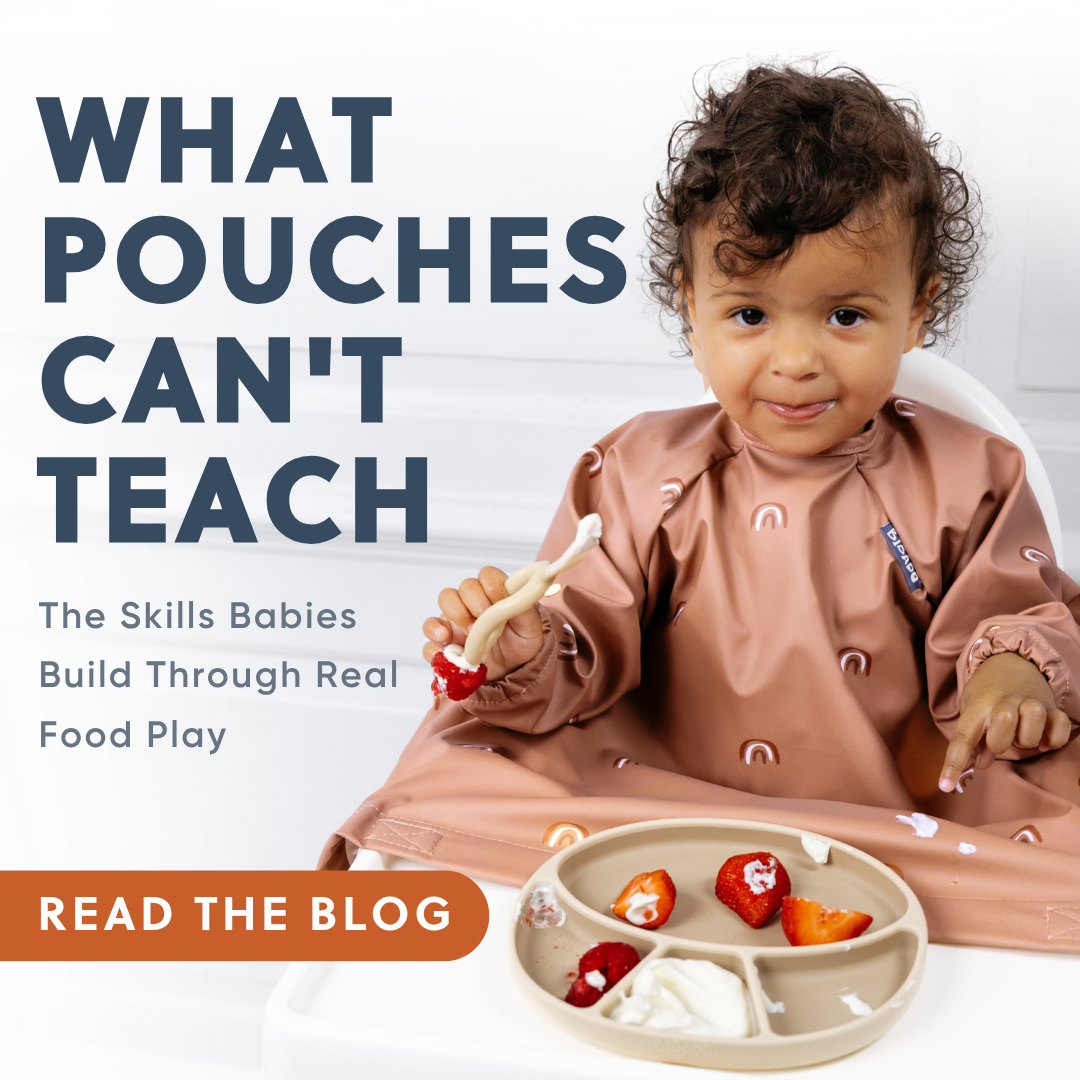
What Pouches Can’t Teach: The Skills Babies Build Through Real Food Play
Pouches can be brilliant. They’re quick, convenient, and often exactly what you need when life is happening at full speed. But when it comes to learning how to eat, they only tell part of the story...
Read moreFollow us for more delicious, nutritious bite-size Bibado goodness
