Mealtime adventures are better with Bibado! Let our award-winning products make a difference to your weaning journey.
 Shop Now
BASKET
Your basket is empty
Mealtime adventures are better with Bibado! Let our award-winning products make a difference to your weaning journey.
Shop Now
Dotty is more than an ordinary teether. She is a multi-sensory mouth muscle gym, turning natural chewing and play into valuable practice for the exciting world of weaning.
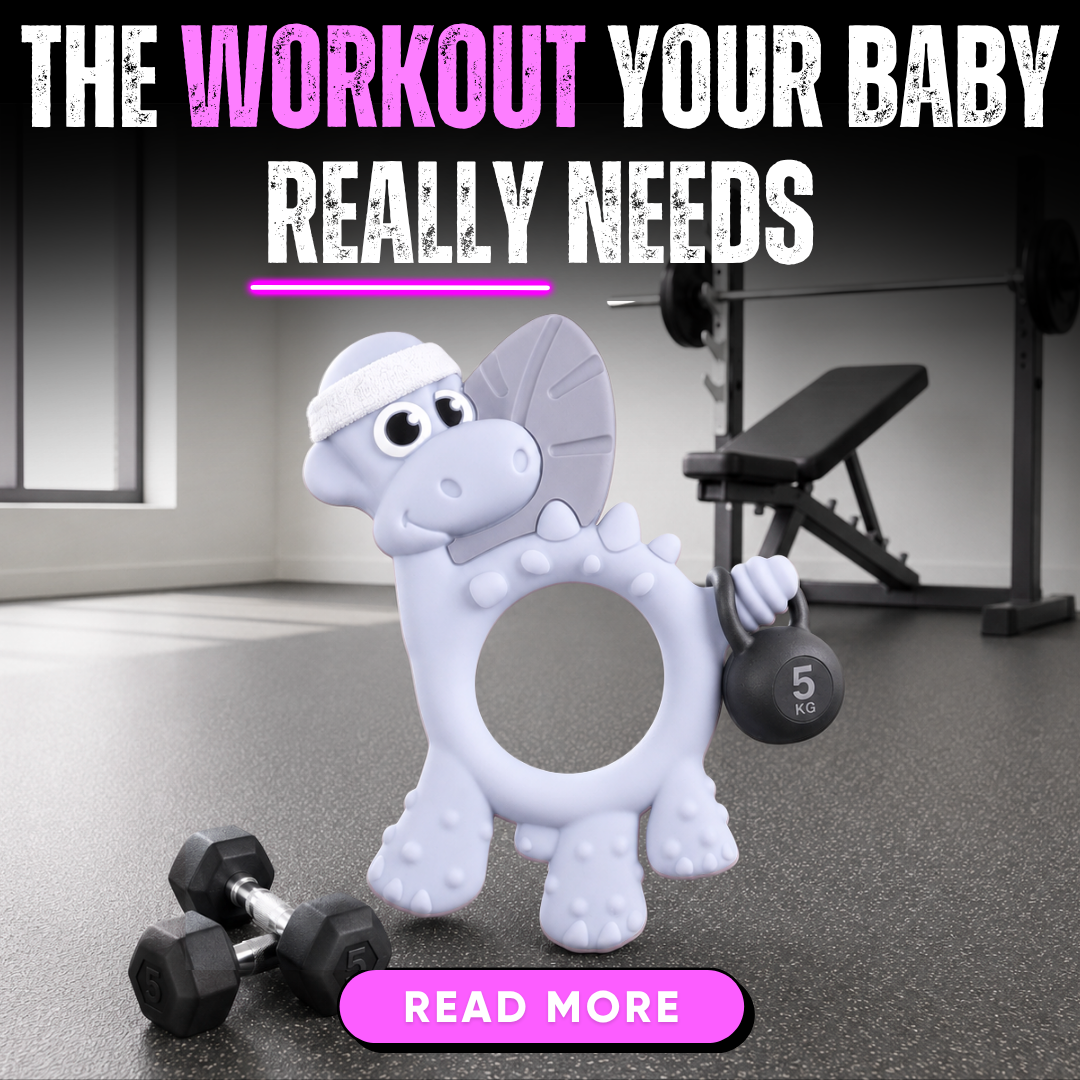
Your baby’s first workout may begin long before they ever set foot in a gym—and it’s happening inside their mouth.
From the day your baby is born, every suckle, lick, chomp, twist and chew can put their tongue, jaw, lips and cheeks to work. These small but surprisingly complex movements help babies develop the oral awareness and coordination they will later rely on to bite, chew, sip and swallow.
What might surprise you more is that a teether can do a lot to support this process - though this is often a missed opportunity because new parents often believe that teethers are solely for soothing gums and for erupting teeth.
Dotty the Dinosaur was designed to do more.
As your baby explores her varied shapes, surfaces and textures, their tongue practises moving from side to side, their jaw works through early chewing movements, and their brain processes new information about pressure, position and sensation.
That is what makes Dotty more than an ordinary teether. She is a multi-sensory mouth muscle gym, turning natural chewing and play into valuable practice for the exciting world of weaning.
Oral motor skills are the coordinated movements of the lips, tongue, cheeks and jaw.
Babies use these structures from birth for sucking and swallowing milk. Eating solid food, however, asks the mouth to work in new and more complex ways.
As babies begin weaning, they gradually learn to:
Close their lips around food and utensils
Use their jaw to bite and munch
Move their tongue from side to side
Transfer food towards the gums for chewing
Gather chewed food together before swallowing
Control saliva and food within the mouth
Adjust their movements for different shapes and textures
These skills do not all appear overnight. Like reaching, crawling or learning to use a spoon, they develop through repeated opportunities to explore and practise.
Milk feeding largely relies on a familiar, rhythmic sucking pattern. Solid food introduces a completely different sensory and motor challenge.
A baby must begin to understand:
Where the food is inside their mouth
How large or firm it feels
Where to move it
How much pressure to use
When it is ready to be swallowed
The tongue plays an especially important role.
Tongue lateralisation is the ability to move the tongue from one side of the mouth to the other.
This helps a baby transfer food away from the centre of the tongue towards the gums, where early chewing movements occur. The tongue must then help gather and reposition the food as it is broken down.
Without effective lateral movement, food may remain in the middle of the mouth or become difficult for a baby to organise.
Tongue lateralisation develops over time and becomes increasingly coordinated as babies gain experience with safe objects and suitable foods. It is one of the important movement patterns involved in developing more mature chewing.
Babies do not need teeth to begin practising chewing.
Their gums are strong, and early chewing usually starts with an up-and-down munching movement. As their oral skills develop, the jaw gradually becomes more controlled and capable of increasingly complex movements.
Jaw stability gives the tongue a steadier base from which to work. The jaw, tongue, cheeks and lips must therefore learn to work as a team rather than as separate parts.
Eating is not purely a motor activity. It is sensory too.
Babies need to process information about:
Temperature
Texture
Firmness
Shape
Taste
Pressure
Position within the mouth
This developing internal map is sometimes referred to as oral awareness or oral mapping.
Exploring safe objects with different contours can help babies learn more about the front, sides and back areas of their mouths. This alone does not teach a baby how to eat, but it can provide valuable sensory experiences alongside safe, age-appropriate food practice.
Gagging is a normal protective reflex and is especially common when babies start eating solid foods.
A baby who is gagging may make a retching sound, open their mouth, water at the eyes or push their tongue forwards to bring food back towards the front of the mouth. Gagging is different from choking, which occurs when the airway is blocked.
The gag reflex helps protect babies as they learn to manage unfamiliar foods. Early in weaning, it may be triggered more easily than in an older child or adult.
As babies gain safe experience with food, they become better at judging where food is, moving it around their mouth and responding to different textures. A teether doesn’t prevent gagging or choking but can help gradually desensitise and move the sensitive newborn gag reflex further back in the mouth. This oral exploration prepares babies for accepting solid foods, managing different textures, and learning to chew
Dotty the Dinosaur was created as a multi-sensory teether to support oral sensory and motor development.
Her unique design provides several different ways for babies to hold, mouth, chew and explore. Rather than offering one uniform chewing surface, Dotty encourages babies to discover different parts of their mouth and experiment with different movements.
Here is how Dotty’s individual features support the journey towards independent eating.
Dotty’s narrow, ridged tail is designed to encourage babies to explore beyond the very front of their mouth.
As a baby mouths the tail, they may use their tongue to locate, investigate and reposition it. Its distinctive shape can encourage side-to-side tongue movements and help babies discover the gums at either side of the mouth.
These are useful foundations for tongue lateralisation, which is later needed to move food towards the gums and reposition it during chewing.
The broad, textured feet provide a larger chewing surface that babies can explore with their gums.
Although babies may not yet have molar teeth, the back gums are an important area for early chewing practice. Bringing a safe chewing surface towards the side gums can encourage the up-and-down jaw movements that form an early munching pattern.
The raised textures also give the mouth additional sensory feedback, helping a baby notice where the teether is and how much pressure they are applying.
Dotty’s soft, chewable head provides a broader surface for babies to mouth and investigate.
The front of the mouth plays an important role in:
Lip closure
Biting food
Removing food from a spoon
Holding an object steady
Beginning to judge its size and shape
Mouthing the domed head can encourage babies to use their lips, front gums and tongue together while experiencing a different shape and level of resistance.
This kind of exploration supports the oral sensory awareness babies need when they begin meeting spoons, cups and finger foods.
Dotty combines smooth, ridged and raised surfaces rather than offering one repetitive texture.
Each new surface produces slightly different sensory feedback. One area may feel soft and broad, while another feels narrow, bumpy or more defined.
This variety gives babies opportunities to adjust their mouth movements in response to what they feel.
During weaning, they will need to make similar adjustments when moving between foods such as:
Smooth yoghurt
Soft avocado
Lumpy porridge
Tender vegetables
Toast fingers
Shredded meat
A teether cannot recreate the full complexity of eating, but sensory variety can help familiarise babies with the idea that different things feel different inside the mouth.
Dotty’s open centre is designed to be easy for small hands to grasp.
A two-handed grip helps babies bring the teether towards the centre of their body and guide it to their mouth. This supports the developing relationship between vision, hand movement and oral exploration.
This matters for independent eating because babies eventually need to coordinate several steps:
See the food or utensil
Reach towards it
Grasp it
Bring it accurately to their mouth
Adjust its position once it arrives
By making Dotty easy to hold from different angles, the design allows babies to practise these early hand-to-mouth movements without requiring a single precise grip.
Independent eating starts long before a baby successfully uses a spoon.
Every time your baby reaches for Dotty, lifts her and turns her around, they are experimenting with grip, wrist position and hand-to-mouth coordination.
Dotty’s curved body and multiple easy-to-grasp sections give babies more than one way to succeed.
This flexibility is important because early independence is not about performing a movement perfectly. It is about having enough opportunities to attempt it.
A flat teether may provide soothing pressure, but it does not necessarily invite much variation in movement.
Dotty’s feet, tail, domed head and body have different widths and contours. This allows babies to explore the front and sides of their gums and find the areas that feel most comfortable during teething.
It also encourages them to rotate and reposition the teether themselves—another useful exercise in motor planning and hand-to-mouth control.
Dotty is not a replacement for food experience. Babies learn to eat by eating, with suitable textures and shapes offered safely from around six months when they show the developmental signs of readiness.
Instead, think of Dotty as a playful companion for the journey.
From three months, allow your baby to hold, mouth and explore Dotty under close supervision.
This gives them early experience of different textures and shapes without expecting them to manage food.
A few minutes of supervised chewing and oral exploration may help an interested baby become more aware of their mouth before sitting down to eat.
There is no need to use Dotty as a formal exercise or insist that your baby chews particular parts.
Let your baby explore Dotty during floor play, while sitting with you or when they naturally reach for something to chew.
This keeps the experience playful and pressure-free.
Once your baby is ready for solids, offer a safe progression of textures rather than remaining with completely smooth purées for longer than necessary.
Food is where babies learn the functional skills of biting, chewing, moving and swallowing. Dotty can complement that experience by continuing to provide varied sensory exploration between meals.
Follow your baby’s lead:
The most useful mouth workout is one your baby chooses to take part in.
There is no perfect number of chews, no required sequence and no need to guide every movement. Babies develop through curiosity, repetition and successful attempts.
Place Dotty within reach and allow your baby to:
Pick her up
Turn her around
Explore different textures
Move her between hands
Bring her to their mouth
Remove and reposition her
Decide when they have had enough
These small actions are all part of learning.
To your baby, Dotty is a friendly dinosaur to grab, chomp and carry on their adventures.
Behind the play, however, their lips, tongue, cheeks, jaw and hands are gaining useful experience. They are discovering new sensations, experimenting with movement and creating an increasingly detailed map of their mouth.
Dotty cannot teach a baby to chew or guarantee feeding outcomes. No teether can. But her thoughtful multi-sensory design gives babies more opportunities to explore the mouth movements and sensory experiences that sit behind eating.
Because before babies can confidently bite, chew and feed themselves, they need time to discover what their amazing little mouths can do.
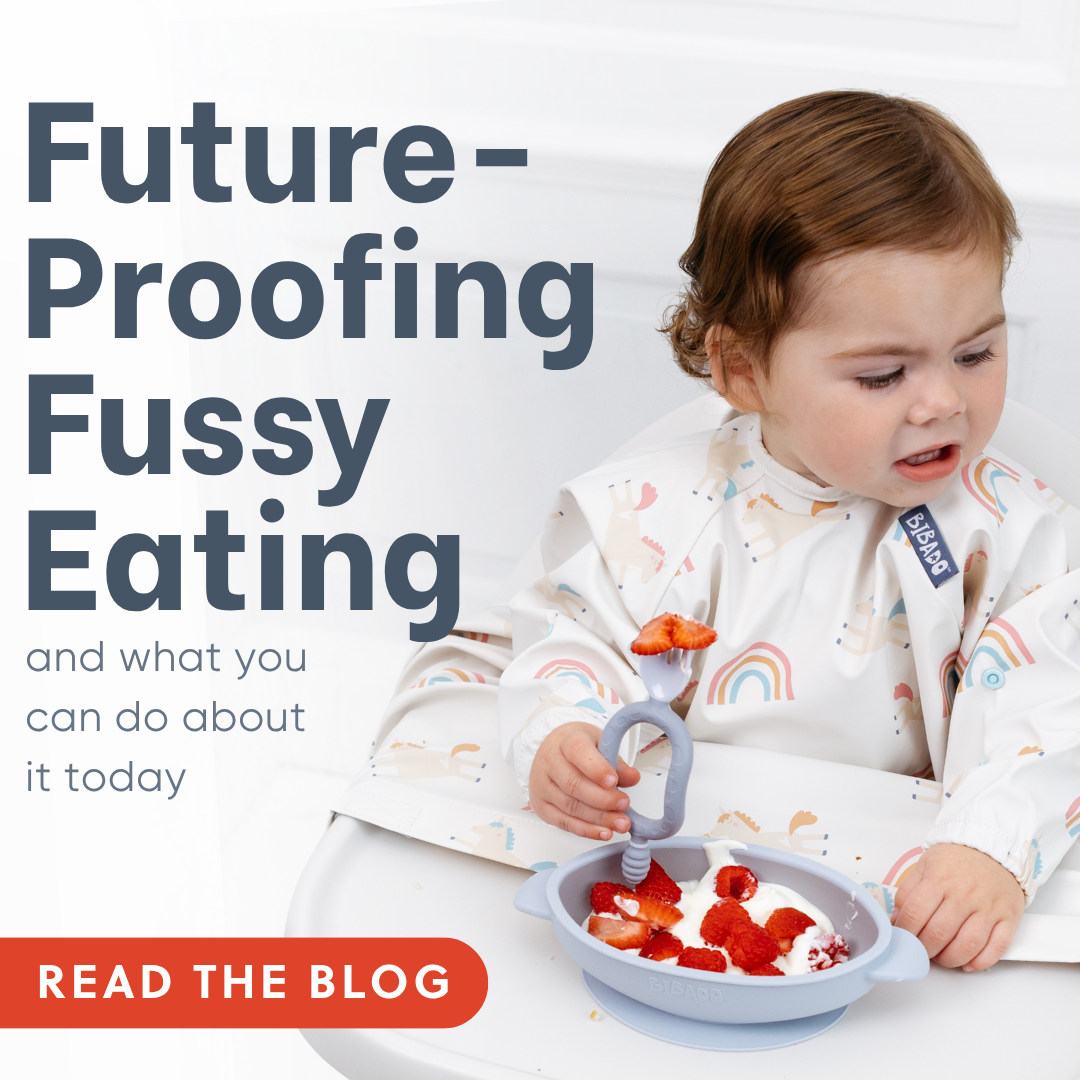
Future-Proofing Fussy Eating: What You Can Do Today
While there's no guaranteed way to prevent picky eating altogether, there are some simple things you can do during weaning that will help to build confidence and curiosity around food, laying the f...
Read more
The Weaning Parent’s Constipation Survival Guide
Constipation is incredibly common in childhood. In fact, children’s bowel and bladder charity ERIC reports that it affects up to 1 in 3 children, and babies can be affected too. The good news? For ...
Read moreFollow us for more delicious, nutritious bite-size Bibado goodness
