Mealtime adventures are better with Bibado! Let our award-winning products make a difference to your weaning journey.
 Shop Now
BASKET
Your basket is empty
Mealtime adventures are better with Bibado! Let our award-winning products make a difference to your weaning journey.
Shop Now
Supporting messy mealtimes does not mean encouraging chaos for the sake of it or engineering elaborate sensory activities. It means creating an environment in which they can be set free to explore without limits. Mealtimes represent a natural opportunity to explore and discover.
Here are 10 practical ways to make space for that learning while keeping mess manageable for the whole family.
Once you understand how much learning can happen during a messy mealtime, the next question is usually:
How do I encourage that exploration without making every meal feel completely overwhelming?
Supporting messy mealtimes does not mean encouraging chaos for the sake of it or engineering elaborate sensory activities. It means creating an environment in which they can be set free to explore without limits. Mealtimes represent a natural opportunity to explore and discover.
For babies, eating is an intensely sensory experience. They are learning how food looks, smells, feels, moves and changes—not just how it tastes. At the same time, they are developing the coordination skills needed to reach, grasp, scoop, bite, chew and drink.
The more freely they can participate, the more opportunities they have to practise.
Here are 10 practical ways to make space for that learning while keeping mess manageable for the whole family.
The easiest way to feel more comfortable with messy mealtimes is to prepare for them.
If you’re worried about stained clothing, difficult clean-ups or food hitting the floor, it is natural to step in more often. You may find yourself removing food, wiping hands or guiding every mouthful simply because you are trying to contain the aftermath.
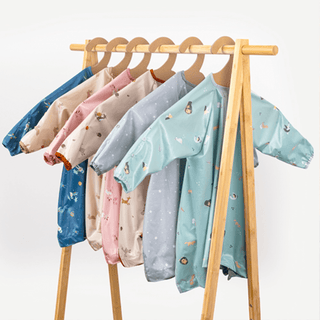
Creating a mess-ready environment can remove some of that pressure. The Bibado Coverall Bib was designed exactly for this reason.
The aim is not to eliminate mess. It is to make it feel manageable enough that you can relax and support your baby to explore freely.
Every texture gives your baby different sensory information.
Smooth yoghurt feels different from mashed avocado. A strip of toast requires a different grasp from a soft piece of pear. Porridge moves differently from couscous, while broccoli offers several textures within one food.
Offering a variety of safe, age-appropriate textures helps your baby build a broader understanding of how food behaves.
You can include foods that are:
smooth or lumpy
firm or soft
wet or dry
sticky or crumbly
warm or cool
This does not mean every meal needs to contain a complicated selection. Even one or two contrasting textures can create a rich learning experience.
Touch is part of eating.
Before babies feel ready to put an unfamiliar food into their mouth, they may need time to look at it, pick it up, squeeze it, smell it or squish it.
These actions help them gather information about its temperature, texture, shape and consistency. They can make the food feel more familiar and predictable before it reaches the mouth.
Try not to treat touching without eating as a failed attempt.
A baby who squashes a new food, licks it or brings it close to their face is still learning about it. Tasting and swallowing may come later, after several exposures.
It can be tempting to wipe your baby’s hands and face after every mouthful, particularly when food begins to spread.
However, frequent wiping can interrupt concentration and remove the sensory information your baby is exploring. Some babies also find having their hands or face repeatedly wiped uncomfortable.
Unless there is a safety concern or your baby is clearly distressed, try waiting until a natural pause or the end of the meal.
Self-feeding is difficult. It’s a skill that needs to be learned, just like walking or talking.
Your baby must locate the food, reach towards it, adjust their hand, grip it with the right amount of pressure and guide it towards their mouth. If they are using a spoon or cup, the task becomes even more complex.
It may take several attempts, so it’s important to understand this and be patient. We often talk about stepping back so they can step up or ‘don’t steal their struggle’. While it can be hard to watch them struggle, you could be stealing valuable experiences that help them solve problems and build the skills they need to eat.
A slippery piece of banana may fall repeatedly before your baby adjusts their grip. A loaded spoon may turn over before it reaches their mouth, or they may repeatedly miss their aim. A piece of broccoli might need to be transferred from one hand to the other.
This trial and error is where much of the learning happens.
Support your baby when they need it, but give them enough time to attempt the action themselves first.
Babies explore more freely when they can clearly see and reach their food. Make sure their highchair seat and position are set up for success and that they are seated at a 90° angle and can see their tableware or the food in front of them.
Try not to overcrowd the plate or bowl. Offering a few manageable portions or pieces of food at a time can make it easier for your baby to focus on each food, pick it up and work out how it moves.
The aim is simply to create a clear, accessible space where your baby can reach, grasp, scoop and explore without becoming overwhelmed. If that sometimes means skipping the tableware and letting them pick it up off the highchair tray, that’s okay.
Preloading a spoon is a simple way to support independent feeding before your baby can scoop food successfully by themselves. We call this assisted feeding.
Load a small amount of food onto the spoon, then place it on the tray or hand it to your baby. Allow them to complete the movement towards their own mouth. We developed Dippit and Sporkit so that they can be used in assisted feeding. Unlike other utensils, they have a two-handed design which makes it easier for your baby to reach and grab with both hands - something far easier for them to accomplish in the early days before wrist control develops.
Preloading creates an achievable challenge. Your baby still gets to practise reaching, grasping, rotating the spoon and coordinating the journey to their mouth, without needing to master scooping at the same time.
Expect some of the food to end up on the tray, face or hands. That is part of the practice.
Babies learn a great deal by watching the people around them.
Sit with your baby where possible and let them see you handle and eat food. You can model simple actions such as picking something up, dipping, scooping, biting or drinking from an open cup.
You can also describe what you are experiencing:
“This avocado feels slippery.”
“The toast is crunchy.”
“The yoghurt is cold.”
Keep the interaction relaxed. The aim is to demonstrate curiosity and model how you eat, but don’t necessarily expect it to lead to them doing the same.
When exploration is playful and pressure-free, babies can engage at their own pace.
Dropping food is a normal part of learning, especially during the early stages of weaning.
Your baby may be exploring cause and effect, practising how to release objects or simply losing control of a difficult-to-hold food. They may also be signalling that they are finished or no longer interested.
Rather than immediately labelling the behaviour as naughty, look at what might be happening.
If your baby is still engaged, calmly return the food once or twice and model placing unwanted food in a particular area of the tray.
You might say:
“You don’t want that. You can put it here.”
If throwing becomes repeated and deliberate, or your baby appears finished, remove the remaining food without turning it into a game or a confrontation.
Messy exploration can have boundaries. Supporting learning does not mean allowing food to be thrown indefinitely.
A successful meal is not defined only by how much your baby swallows—or by how clean they remain.
During weaning, learning can happen long before food is eaten.
Your baby may have made progress if they:
looked closely at an unfamiliar food
touched a texture they previously avoided
picked something up independently
changed their grip after dropping it
brought a spoon towards their mouth
licked or tasted a new food
practised drinking from an open cup
remained calm and curious around the meal
These interactions build sensory familiarity, coordination and confidence.
Try not only to think of a mealtime in terms of how much they ate. Try asking: “What did they explore, practise or discover today?”
Not every baby immediately enjoys food on their hands or face.
Some will happily dive into porridge from their first meal. Others may hesitate to touch sticky or unfamiliar textures, hold their hands away from the tray or become upset when food gets on their skin.
Avoid forcing their hands into food or deliberately smearing it onto them. This can make the experience feel unpredictable and may increase their resistance.
Instead, build familiarity gradually. The aim is not to push your baby into tolerating mess. It is to help them feel safe enough to explore at their own pace.
Speak to a health professional if your baby shows persistent or significant distress around a wide range of textures, avoids touching food entirely or has feeding difficulties that concern you.

What Happens Inside Your Baby's Brain During a Messy Mealtime?
To you, it looks like lunch, breakfast or dinner. For your baby's brain, it's one of the richest developmental workouts of the day. Every time they squash a raspberry, reach for a spoon, smell a pi...
Read more
The 10 Signs You're Doing Messy Mealtimes Brilliantly
Some days you'll witness obvious breakthroughs. Other days, the learning will be happening quietly behind the scenes as your baby builds confidence, sensory awareness and lifelong eating skills. Yo...
Read moreFollow us for more delicious, nutritious bite-size Bibado goodness
