Mealtime adventures are better with Bibado! Let our award-winning products make a difference to your weaning journey.
 Shop Now
BASKET
Your basket is empty
Mealtime adventures are better with Bibado! Let our award-winning products make a difference to your weaning journey.
Shop Now
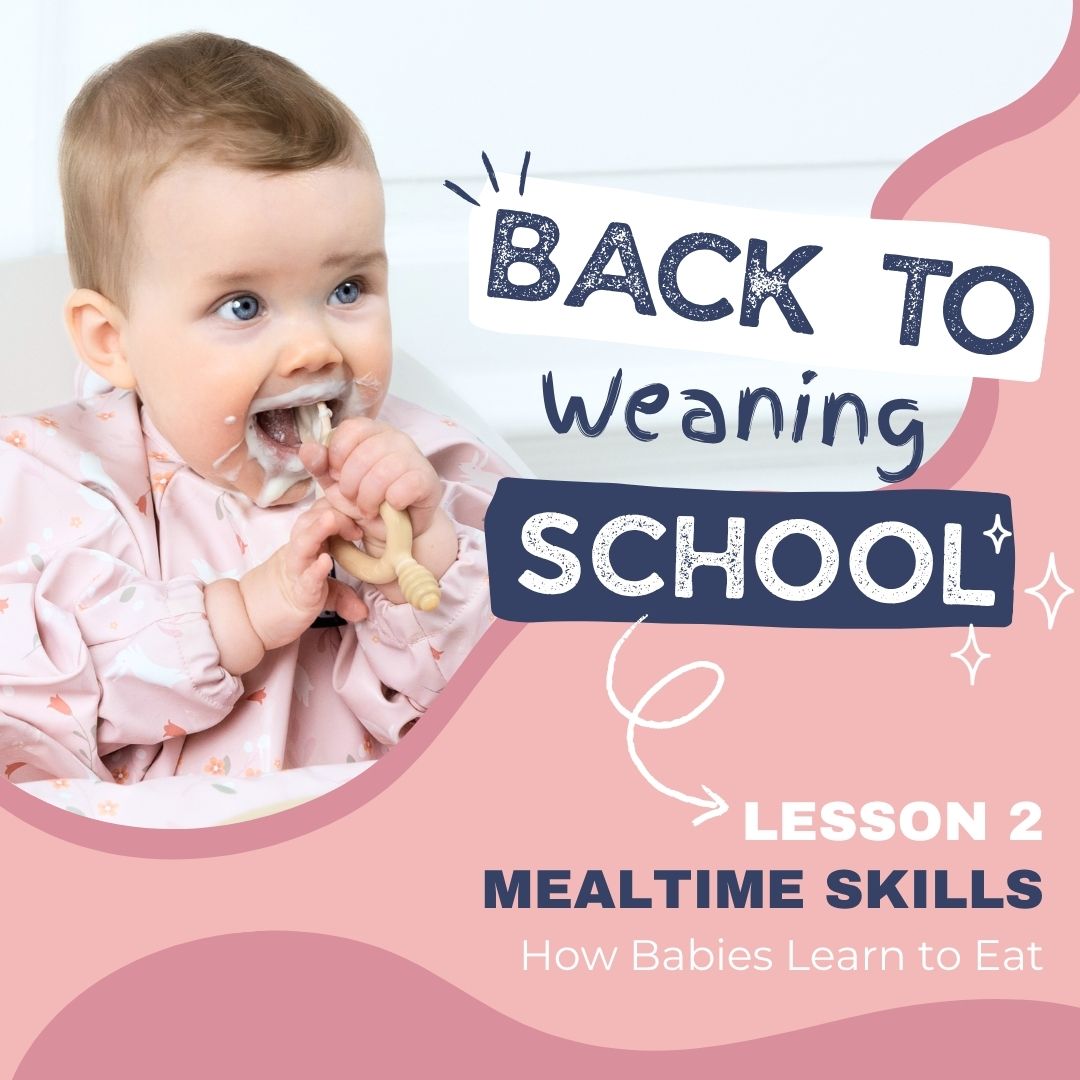
In Lesson 1 of our Back to Weaning School series, Weaning 101, we answered 20 of the questions parents ask most about starting solids.
Now it’s time for Lesson 2 — and a closer look at what’s actually happening once your baby gets to the table.
Because babies aren’t born knowing how to eat.
Reaching for food, picking it up, getting it to their mouth, biting, chewing, moving food around, swallowing, drinking from a cup and eventually wielding a spoon or fork are all skills that have to be learnt.
And just like crawling, walking or talking, they take opportunity, repetition and lots of practice.
So if you’ve ever watched your baby squash a banana, chew the wrong end of a spoon or drop the same piece of broccoli for the sixth time and wondered, “Are they actually learning anything here?”
The answer is very probably yes.
Welcome to Mealtime Skills Class.
Because weaning isn’t only about what gets eaten. Every grasp, squish, bite, sip and slightly wonky spoonful is helping your baby learn how to become an eater.
WHAT SKILLS DOES A BABY NEED TO LEARN TO EAT?
Quite a few.
Eating might feel automatic to us, but think about everything involved in taking just one mouthful.
Your baby needs to notice the food, reach towards it, judge where it is, grasp it with the right amount of pressure, move it towards their mouth, open their mouth at the right moment, bite or take some food, use their tongue and jaw to manage it, and then coordinate swallowing.
And that’s before we introduce cups and cutlery.
Mealtimes bring together fine motor skills, hand-eye coordination, oral motor skills, sensory processing, balance, posture, problem-solving and self-feeding.
No wonder it can get messy while they work it all out.
WHY IS REACHING FOR FOOD IMPORTANT?
Before your baby can feed themselves, they have to learn how to get food from the table to their mouth.
Reaching might look simple, but your baby is coordinating what they can see with how they move their arm and hand.
At first, their movements can be wonderfully inaccurate. They may overshoot the food, knock it over or grab an entire handful when they were aiming for one piece.
That’s not a problem to correct. It’s practice.
Giving your baby opportunities to reach for food themselves helps them develop the hand-eye coordination they’ll eventually use for everything from self-feeding to drawing, dressing and countless other everyday tasks.
TRY THIS:
Put a few pieces of food within easy reach rather than constantly placing food directly into your baby’s hand or mouth.
Give them a chance to problem-solve and work out how to get there.
WHY DOES MY BABY GRAB FOOD WITH THEIR WHOLE HAND?
Because that’s the grasp they have available to them.
Early in weaning, babies commonly use a palmar grasp, wrapping their fingers around food and holding it in their fist.
That’s one reason larger finger-shaped pieces of soft food can work so well at this stage: your baby can grip the food while leaving enough sticking out of their hand to explore with their mouth.
As their fine motor control develops, you’ll begin to see a much more precise movement emerging: the pincer grip, where the thumb and forefinger work together to pick up smaller pieces.
Suddenly, that pea that was almost impossible to retrieve becomes an achievable target. Of course, you could introduce our Sporkit - that works wonders on hard-to_retrieve foods, too!
The change might seem small, but it’s a huge leap in dexterity.
WHY DOES MY BABY SQUEEZE AND SQUASH THEIR FOOD?
Because they don’t yet know that avocado needs a gentler grip than toast.
They have to learn that.
Food gives babies an extraordinary variety of physical information. It can be firm, slippery, sticky, crumbly, wet, springy, smooth or rough.
When your baby picks food up, they are learning how much force they need to use.
Too little pressure and it slips away. Too much and — goodbye banana.
This is part of developing grip control and learning to adjust their movements according to what they’re holding.
So the squashing isn’t necessarily getting in the way of the meal. Sometimes it is the lesson.
WHY DOES MY BABY KEEP DROPPING FOOD AND SPOONS?
Sometimes because they lost their grip.
Sometimes because they haven’t yet mastered releasing something exactly where they intended.
And sometimes because dropping a spoon from the highchair and discovering that it falls down every single time is genuinely fascinating when you’re a baby.
Releasing objects deliberately is another motor skill.
Your baby is learning the difference between holding on and letting go, while also discovering cause and effect.
Yes, it can be frustrating when you’re retrieving the spoon for the tenth time.
But not every dropped spoon needs rescuing immediately. Giving your baby more than one utensil, for example, can allow the meal to continue without turning you into a full-time spoon retrieval service. It's why we sell Dippit and Sporkit in a two-pack!
HOW DO BABIES LEARN TO CHEW?
Chewing isn’t dependent on having a mouthful of teeth.
Babies can use their gums, jaw, tongue, lips and cheeks to manage appropriately soft foods long before their molars arrive.
One important part of learning to eat is developing the ability to move food around the mouth.
Your baby’s tongue gradually becomes more skilled at moving food from the centre of the mouth towards the sides, where it can be worked on by the gums before being gathered ready to swallow.
Different safe, age-appropriate textures give the mouth different problems to solve.
A smooth yoghurt doesn’t require the same movements as a soft piece of broccoli, toast or ripe pear.
That’s why progressing through textures is about more than simply adding variety to the menu.
Texture is practice for the mouth.
DOES MY BABY NEED TO LEARN HOW TO SWALLOW SOLID FOOD?
Yes.
Sucking and swallowing milk is something your baby has been practising from birth, but solid food presents a completely different challenge.
Now food needs to be bitten or broken down, moved around the mouth, gathered into a manageable mouthful and coordinated safely with swallowing.
That requires timing and practice.
It’s one of the reasons the early stages of weaning can look so inefficient to adult eyes.
Your baby isn’t simply eating a smaller version of the way you eat.
They’re building the process almost from scratch.
WHY DOES MY BABY GAG WHEN LEARNING TO EAT?
Gagging is a normal protective reflex and a common part of learning to manage solid food.
As babies explore new shapes and textures, food can travel to an area of the mouth that triggers the gag reflex. The body responds by bringing it forward again.
It can look alarming — particularly the first few times you see it — but gagging and choking are not the same thing.
Learning to recognise the difference is one of the most useful things a parent can do when starting solids.
READ NEXT: Gagging vs choking — what’s actually happening?
And we’d always recommend that parents and anyone regularly caring for a baby complete an infant first-aid course.
WHEN SHOULD MY BABY START FEEDING THEMSELVES?
Self-feeding can begin from the start of weaning.
That doesn’t have to mean following a strict baby-led weaning approach.
Your baby can be spoon-fed some foods while also being given finger foods, a preloaded spoon or opportunities to bring food to their own mouth.
What’s important is participation.
When babies feed themselves, they’re not only practising the physical movement of hand to mouth. They’re also getting opportunities to respond to their own appetite and decide whether to take another mouthful.
You don’t have to choose between helping your baby and letting them do it themselves.
Often the sweet spot is giving them just enough support to succeed without doing every part of the task for them.
WHEN SHOULD MY BABY START USING A SPOON?
You don’t need to wait until your baby is capable of scooping neatly before you introduce one. Spoon skills develop in stages.
Initially, you might load the spoon for them and let your baby work on gripping it and getting it to their mouth.
That’s already quite a task.
They have to hold the handle, keep the food more or less on the spoon, orient it towards their face and judge where their mouth is.
Later comes the considerably harder job of scooping food onto the spoon themselves.
So if your baby’s early attempts involve turning the spoon upside down just before it reaches their lips, don’t rush to correct every attempt.
The yoghurt may not have made it in. The practice still counted.
WHEN SHOULD BABIES START USING A FORK?
Fork skills tend to come after those earliest attempts at holding and using a spoon.
Spearing food requires your baby to control the utensil, aim at a target and apply enough downward pressure to pick the food up before transporting it to their mouth.
That’s a lot of coordination.
You can make the job easier by offering soft pieces of food that can be speared relatively easily and letting your baby practise when they’re interested. Again, we developed Sporkit because the fork tips are engineered to spear food more easily, giving your little one an earlier taste of success and keeping them engaged.
Again, don’t measure success by how elegantly dinner reaches the mouth.
Cutlery control develops over time.
WHY SHOULD BABIES LEARN TO DRINK FROM AN OPEN CUP?
Drinking from an open cup is another completely new movement pattern.
Instead of sucking, your baby needs to bring the cup towards their mouth, control its angle, close their lips around the rim, manage the flow of liquid and coordinate a swallow.
That’s a surprising amount of work for a sip of water.
From around six months, you can begin offering small sips of water with meals from an open or free-flow cup like the Sippit.
At first, you’ll probably help hold and tilt the cup.
Then gradually, your baby can take on more of the job.
And yes, some of the water will probably travel down their front.
They’re learning.
WHY DOES SITTING POSITION MATTER WHEN BABIES EAT?
Because feeding skills don’t only involve the hands or mouth.
We eat with our whole body.
Your baby needs to be seated safely and upright with good support so they can concentrate on eating and swallowing rather than using all their energy trying to stabilise themselves.
A secure position provides the foundation for reaching, grasping, bringing food to the mouth and controlling movements.
Think about trying to eat your own dinner while balancing on an unstable stool with your feet dangling in the air. Leading Paediatric Dietitian, Lucy Upton, talks about it in her blog 90/90/90: Why Your Baby Needs Their Feet To Eat
You’d probably find using your knife and fork harder too.
A stable body creates a better platform for everything happening above it.
IS PLAYING WITH FOOD ACTUALLY HELPING MY BABY LEARN?
Almost certainly, yes.
What adults call “playing” can be valuable sensory exploration.
Before confidently eating an unfamiliar food, your baby may want to look at it, touch it, squash it, smell it, lick it or put it into their mouth and take it back out again.
All of those experiences are giving their brain information.
Food isn’t predictable.
Yoghurt behaves very differently from toast. A raspberry collapses. Pasta slides. Broccoli breaks apart.
Babies have to build that knowledge through experience.
You don’t need to turn every mealtime into a sensory play session, but allowing some safe exploration can be an important part of becoming familiar and comfortable with food.
READ NEXT: Why Mess Matters at Mealtimes
WHY DOES REPETITION MATTER SO MUCH?
Because skills don’t normally appear after one attempt.
Think about learning to drive, tie shoelaces or use chopsticks.
You had to repeat the movement until something that initially required enormous concentration gradually became automatic.
Babies are doing the same thing.
One opportunity to hold a spoon won’t teach spoon control.
One sip won’t master an open cup.
One piece of finger food won’t perfect hand-to-mouth coordination.
Practise. Repeat. Skill build.
That’s why regular opportunities matter more than perfect individual meals.
SHOULD I HELP MY BABY OR LET THEM STRUGGLE?
Help is useful.
Taking over isn’t always necessary.
If your baby is working hard to pick up a slippery piece of food, orient a spoon or work out how to get something to their mouth, it can be tempting to solve the problem immediately.
But sometimes that manageable struggle is exactly where the learning is happening.
Give them a moment.
You can make the task a little easier, reposition something within reach, preload a spoon or demonstrate what to do without necessarily completing the whole action for them.
At Bibado, we sometimes describe this as “don’t steal the struggle”.
Not because babies should be left frustrated, but because doing everything for them can remove the very opportunity they need to work something out.
Support the attempt.
Let them own the achievement.
WHAT DOES PROGRESS IN WEANING ACTUALLY LOOK LIKE?
It doesn’t always look like eating more.
Progress might be:
A baby who used to grab food in their fist beginning to pick up a small piece between finger and thumb.
A spoon reaching the mouth with slightly less yoghurt on the table.
A new texture being chewed rather than immediately pushed out.
Two hands around a cup becoming one.
A food that was previously ignored being touched.
A baby reaching for their own food rather than waiting to be fed.
These tiny changes are easy to miss when we’re focused on how many mouthfuls were eaten.
But they’re often signs that skills are developing underneath.
HOW CAN I HELP MY BABY DEVELOP MEALTIME SKILLS?
You don’t need to turn dinner into a developmental exercise. It's already one of the richest learning opportunities in their day.
In fact, the best thing you can often do is create an environment that gives your baby plenty of opportunity to practise.
Try to:
• Seat them safely, upright and securely
• Offer age-appropriate finger foods they can pick up themselves
• Let them touch and explore different textures
• Introduce a spoon early, even before they can use it “properly”
• Offer water from an appropriate cup from around six months
• Give them time to attempt things before automatically stepping in
• Eat together where you can so they can watch and copy you
• Expect mess and make it manageable rather than trying to prevent it completely
• Keep giving them opportunities to repeat emerging skills
Most importantly, try not to compare one mealtime — or one baby — with another.
Development isn’t a straight line.
Some days your baby will seem to crack something completely.
The next day the spoon will be back on the floor.
That’s learning.
FROM EATING FOOD TO LEARNING HOW TO EAT
It’s easy to look at weaning through an adult lens.
We serve the food. The baby eats the food. Successful meal.
But there’s so much more happening at the table.
Your baby is learning how their hands work. How their mouth works. How different foods behave. How to coordinate movement. How to solve problems. How to participate in family mealtimes and, little by little, how to do more for themselves.
That’s why at Bibado, we think about weaning as more than simply introducing solids.
It’s a period of extraordinary development — with multiple opportunities to learn, practise and repeat every single day.
So the next time the spoon is upside down, the broccoli is being meticulously deconstructed, or the cup has missed their mouth entirely, look a little closer.
They’re not just eating. They’re learning how.
LESSON 3: WEANING MYTHS, BUSTED — THE ADVICE PARENTS CAN IGNORE
We’ll put some of the most common weaning advice to the test — and separate the genuinely useful guidance from the myths parents can stop worrying about.
Baby Weaning 101: 20 Questions Every Parent Asks
Starting weaning can bring a lot of questions. From first foods and allergens to gagging, iron, textures and cups, we answer 20 of the most common baby weaning questions with practical, expert-info...
Read more
10 Baby Weaning Myths Busted: The Advice Parents Can Ignore
Starting solids seems to come with an extraordinary number of rules. Start with purées. Never use purées. Let them feed themselves. Don’t let them play with their food. Finish the bowl. Avoid aller...
Read moreFollow us for more delicious, nutritious bite-size Bibado goodness
